A metadata-driven platform that profiles your source systems, maps fields to the target, runs the migration into a file or straight into the target's own API, and reconciles the result, with an AI consultant reviewing every stage.
Pick a capability to see what it does. From first connection to final sign-off, every stage is automated, measured and reviewable.
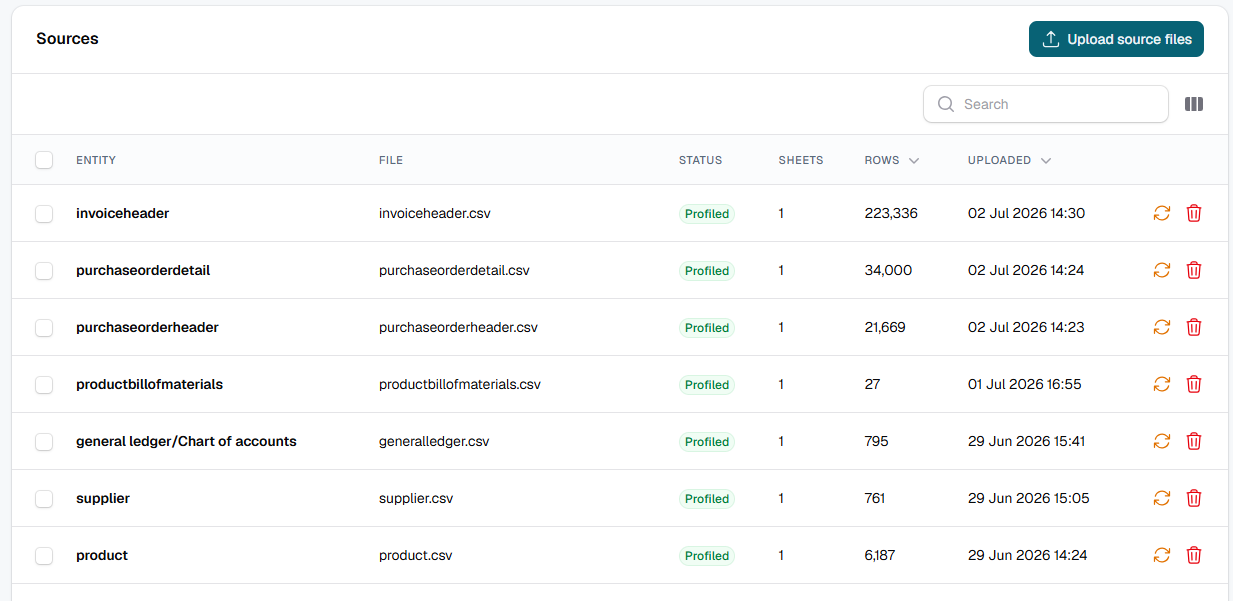
Upload CSV, XLSX or PDF, point at a SharePoint, OneDrive or Azure folder that fetches its own files, or connect live to SQL Server, MySQL, PostgreSQL and generic ODBC systems, including legacy ERPs.
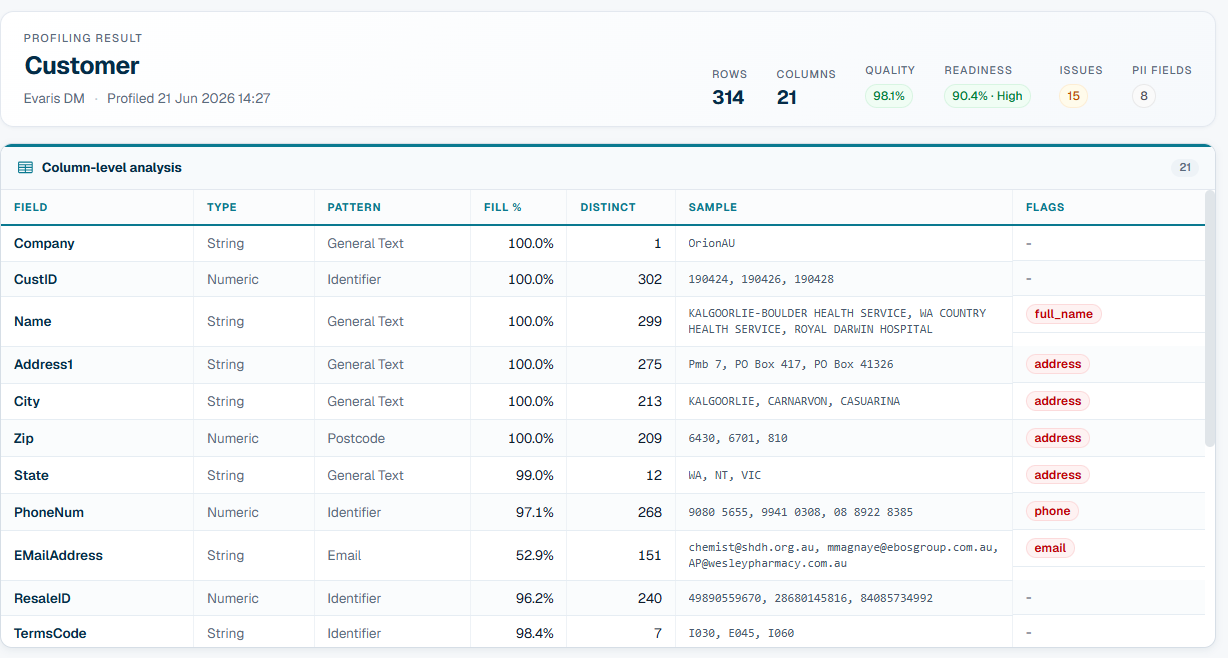
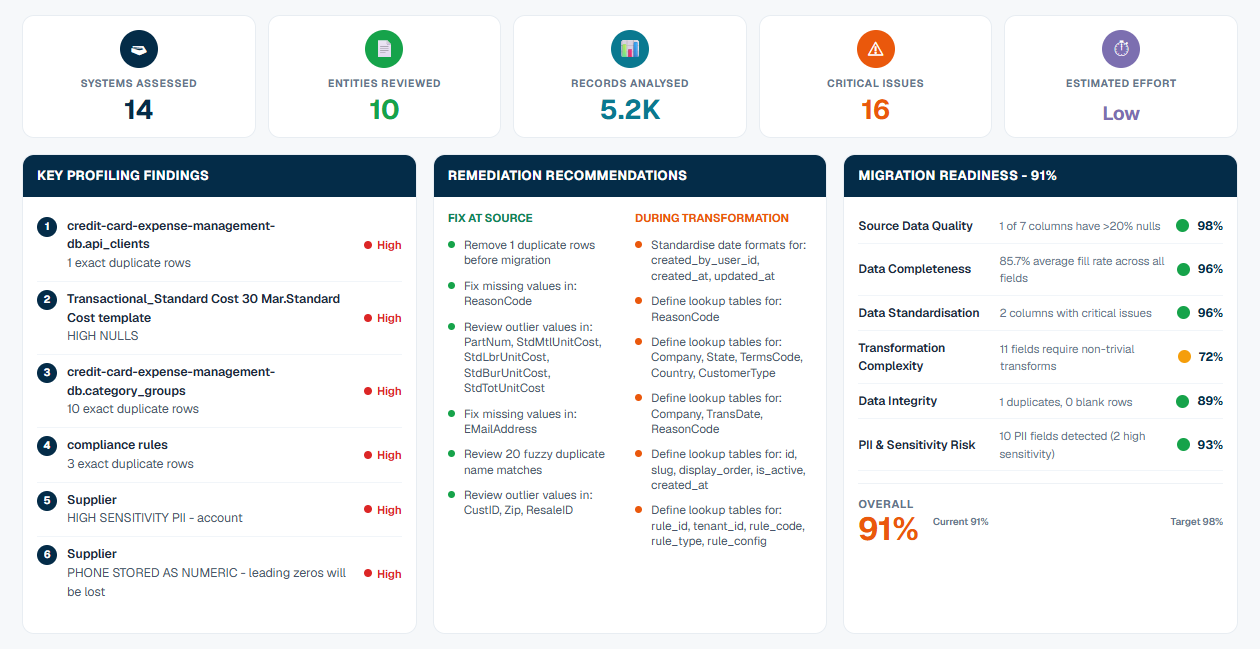
Per-column types, patterns, fill rates, distinct counts, primary-key candidates, duplicates and a data-quality score for every source, with phone columns counted by digit length before anybody converts one.
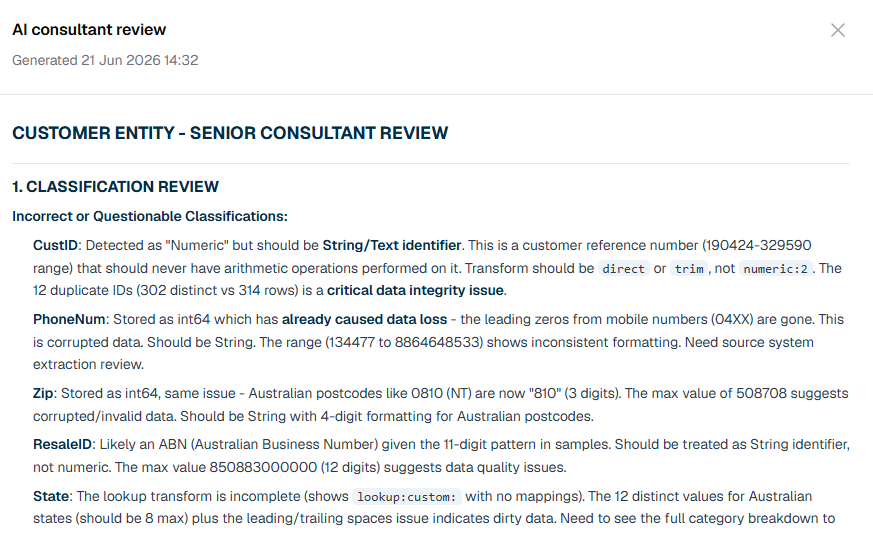
A senior-consultant AI cross-validates the profiling, flags migration risks and PII exposure, and gives a clear go or no-go verdict per entity. Choose the model per project, or leave it on the house default.
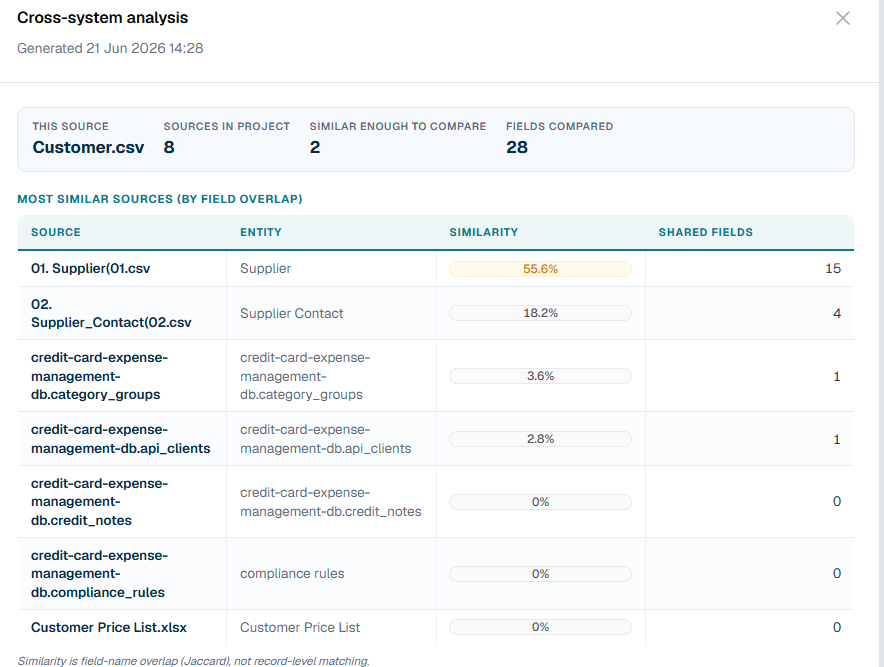
Compares the same data across every source by field similarity, surfaces overlaps and gaps, and recommends the master source.
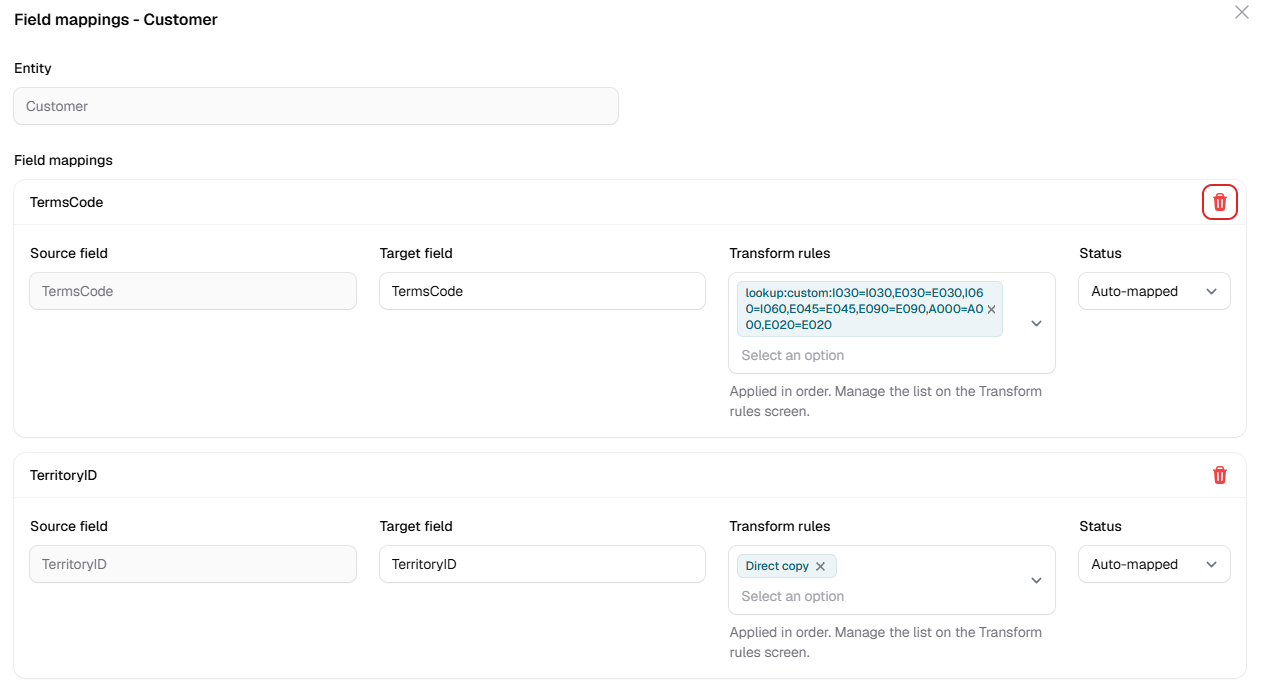
Parse the target template and map source to target fields, with LLM-proposed mappings, confidence scoring and reversible overrides. One target field can be built from several source columns.
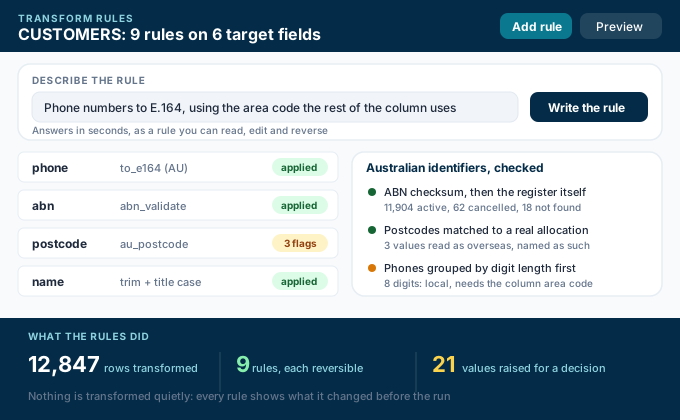
Describe the change and get a rule back in seconds, readable, editable and reversible. Australian identifiers are checked rather than assumed: ABNs against the register itself, postcodes against real allocations, phone numbers into E.164.
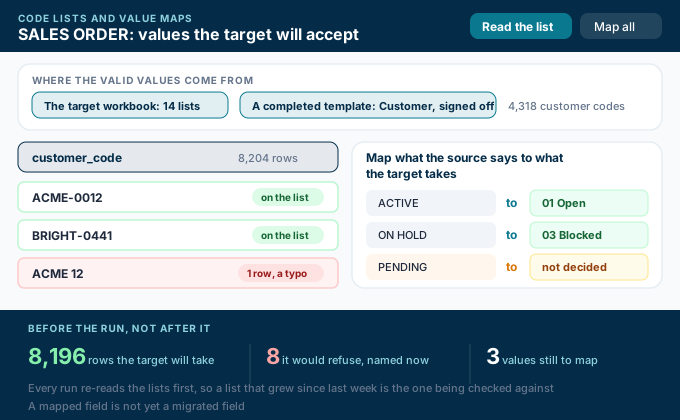
Code lists come out of the target workbook, and out of templates the project already transformed, so a sales line can only name a customer that went in with the customer load. Map what the source says to what the target takes before the run, not after it refuses.
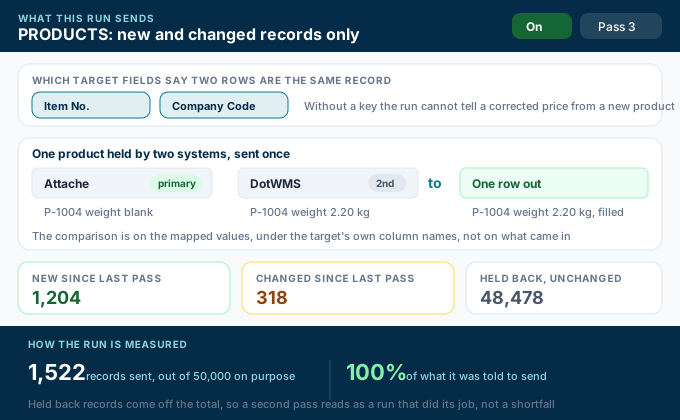
Name the target fields that identify a record and a run sends only what is new or has changed since the last one. One record held by two systems goes out once, taking the system somebody made primary and letting the other fill its blanks.
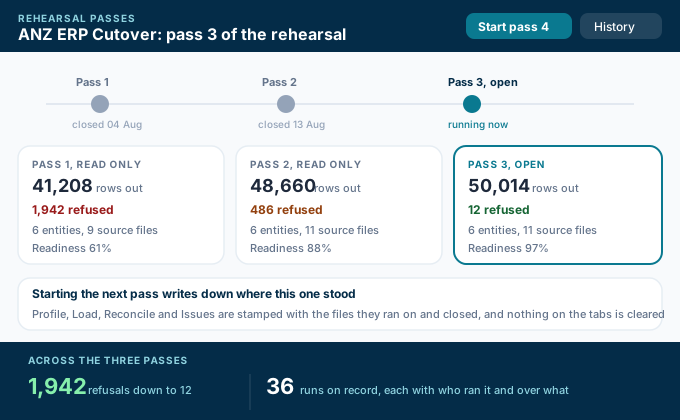
A migration is rehearsed, and every pass is kept: starting the next one writes down where Profile, Load, Reconcile and Issues stood, with the files it ran on and its totals. Earlier passes stay readable and nothing is overwritten.
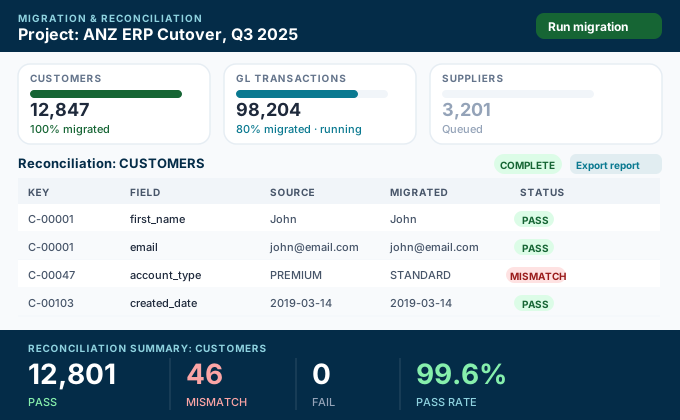
Run the mapped transform, then reconcile source against transformed with pass, mismatch and fail status to confirm nothing was lost. Every run is on record with who started it, and can be undone.
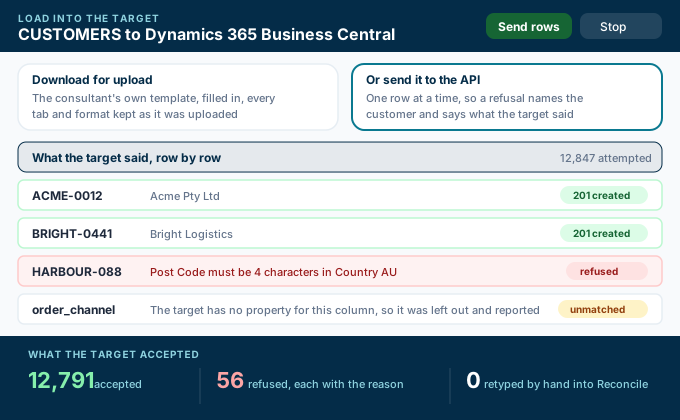
Take the filled-in template away, or send the signed-off output straight into Dynamics 365 Business Central through its own API. Rows go one at a time, so a refusal names the record and repeats what the target said instead of being retyped.
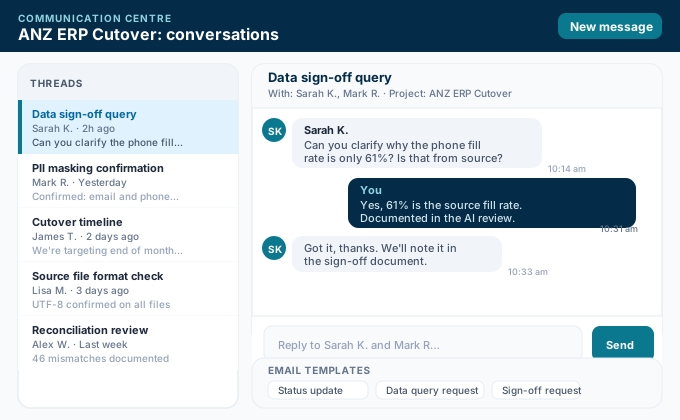
Threaded conversations with project contacts, templated emails, send and receive through your own mailbox, all logged per project. Clients follow their own migration in a portal of their own and sign off there.
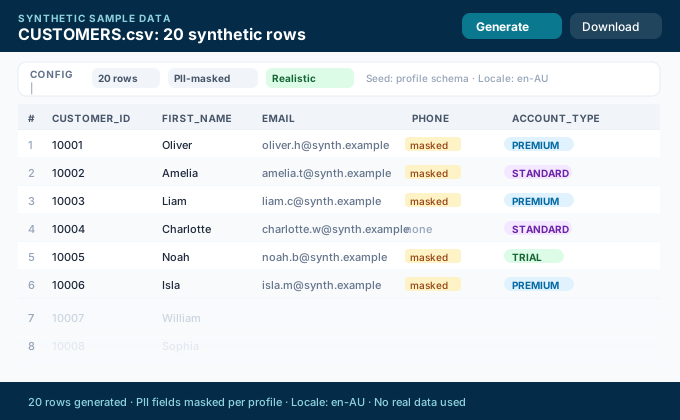
Generate realistic, PII-aware sample data straight from a profile, so testing and demos never touch real records.
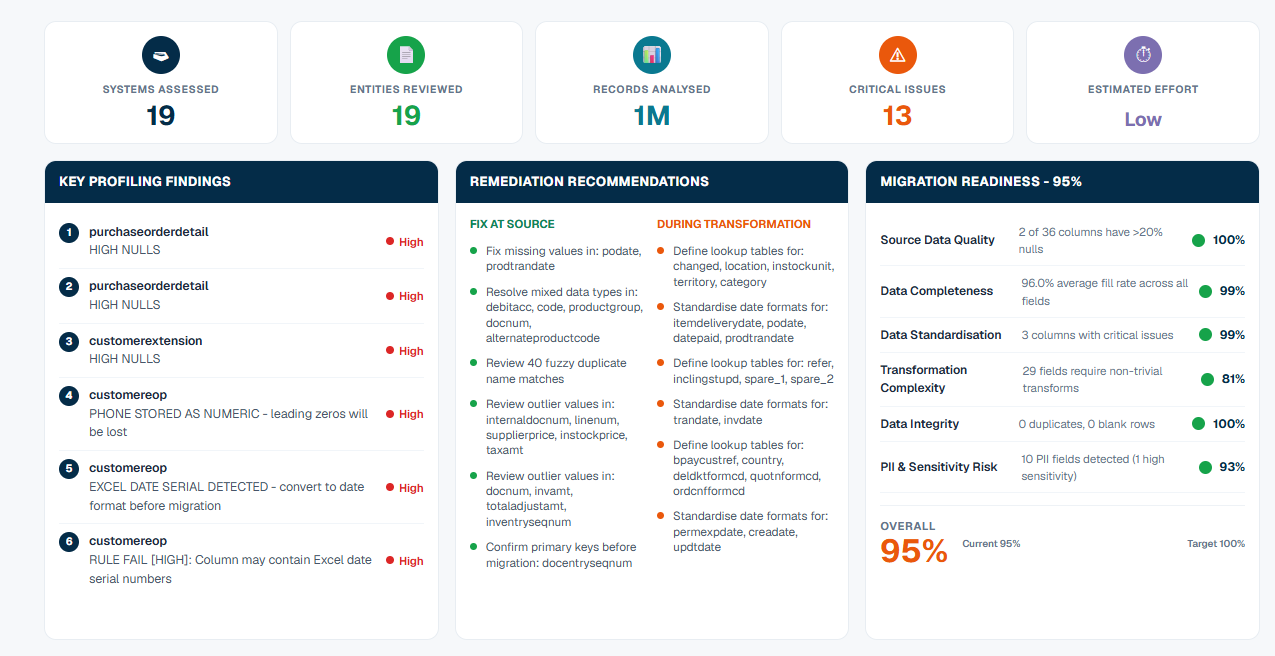
A live dashboard across every project: systems assessed, records analysed, critical issues and overall transformation readiness, with each project opening on the step it is actually on.
Each step is tracked, auto-advanced as work begins, and signed off by a consultant.
Set the functional scope and list the business entities the migration will cover.
Connect the different source types: uploaded files, cloud folders that fetch their own files, or live databases.
Extract the data from every source and profile each column automatically.
Review the profiling, cross-system analysis and AI consultant review.
Build a target template per entity or sub-table by hand, or upload a template file.
Enrich the data, apply the transform rules and map source fields to the target, checking every value against the lists the target will accept.
The client validates and approves the mapped data before load.
Load the data into the target ERP, by file or straight through its API, and verify by exporting the entity back.
Cross-verify our output against the ERP export and sign off that everything aligns.
Most of these came from consultants and clients partway through a real migration. If yours is not here, ask us and we will add it.
Spreadsheets, CSV files and PDFs that you upload. Folders in SharePoint, OneDrive or Azure that it collects new files from on its own. And live connections to SQL Server, MySQL, PostgreSQL and anything that speaks ODBC, which is how most older ERP systems are reached.
It reads the first several rows and works out which one holds your column names, and it is usually right. When it is not, open the Actions menu on that file and choose "Where the headers are". Type the row number the way Excel counts it down the left hand side.
Leaving the box empty means work it out for me. It never means row one.
Only if you let them be. On the same menu, "Which rows are records" lets you say where the last real record sits, stop at the first blank row, or treat a row as junk when a column you nominate is empty. Set it once and every run after that respects it.
No. When you connect a workbook it asks about each tab in turn, so you can bring in one tab and leave the rest alone. You can also send different tabs to different entities, or stack twelve monthly tabs into a single output file if that is what you are after.
Yes. The usual case is a vendor list in one file and the bank details in another. Both are connected to the same entity, and the mapping pulls from either of them.
It can, including scanned ones. Tables come out as tables. A PDF will never be as clean as a spreadsheet, so look at the preview before you build anything on top of it.
Up to 100 MB per upload. If your extract is larger than that, a live database connection is usually the easier road anyway.
No, and this one catches people out. Every run reads the copy that was uploaded here, not the file on your machine, and nothing is held over from the run before.
Upload it again under the same name with overwrite ticked. Your connections, mappings and rules all stay exactly where they were.
No, and you should not feel pushed into it. A target field with nothing mapped to it still comes through in the output, empty, in the order the template puts it in.
If you want to be explicit, mark the row "leave it blank". It goes grey, it says so on screen, and it stops being counted as work outstanding.
Not quite. A fixed value goes out exactly as you typed it, so that writes the four letters NULL into every single row. The screen now warns you when you do it and offers to mark the field as deliberately blank instead, which is what you were after.
Yes. You list what the source says next to what the target expects, and every run applies it. The list can be typed, loaded from a file, or filled in from the values already sitting in your data.
The reconciliation report then tells you which source values still have nothing against them, so nothing slips out untranslated.
Yes, and it works the other way too. One column can fill several target fields, and one source value can be split across several rows in the target.
No. You describe the change in ordinary words and get a rule back in a few seconds, which you can read, edit or take off again.
Australian details are checked rather than guessed at: ABNs against the register, postcodes against the suburb and state they really belong to, phone numbers put into one consistent format.
You change it. Every suggestion carries a confidence score, every one can be overridden, and the override sticks. Nothing is mapped behind your back and nothing counts as settled until a person confirms it.
That is the normal way to work. A migration is rehearsed, and each rehearsal is kept rather than written over. Starting a new one records where profiling, loading, reconciliation and open issues stood at that moment, along with the files it ran on and the totals it produced. The earlier passes stay readable.
Yes. Name the fields that identify a record and the next run sends only what is new or different. Where two systems hold the same record it goes out once, taking whichever system you made the primary one and letting the other fill in the gaps.
Every run is reconciled. The source is compared against what came out, with a pass, mismatch or fail against each entity, and the whole report can be exported.
Blanks you chose are counted separately from blanks nobody got to, so an empty column is never a mystery.
Yes. Runs are on record with who started them and when, and they can be rolled back. Output files are named by project, entity and time, so it is always obvious which file came out of which run.
Both are on offer. Dynamics 365 Business Central has a direct connection, and rows go across one at a time, so a refusal names the record and repeats what Business Central said about it rather than making you guess.
For any other target, including NetSuite, you take the filled in template away and load it the way you normally would. Tell us which system you are moving to and we will look at building a direct connection for it.
Yes, into chunks of whatever size you choose. That is usually the sensible thing to do when the target has an import limit of its own.
They can. Clients get a portal of their own with their progress, the data quality findings, what their codes are being turned into, and their files. They approve the mapped data in there, and they can flag a problem against a named field instead of writing you an email about it.
There is a house default so it works from the first day. You can point a single project or a whole client at a different model, including one you host yourself. The setting is read from the project first, then the client, then the default.
No. It profiles, reviews and suggests, and it says why each time. A person confirms the mappings, a person starts the run, and your client signs off before anything is loaded. Every step is written down and can be read back later.
The platform runs on Microsoft Azure. Files stay inside the project they were uploaded against, and people only see the clients they have been given access to.
If you need the specifics on region, retention and where the model itself runs, ask us and we will put it in writing for you.
No. If you are comfortable in Excel you will be fine here. The parts that would normally need a developer, which is the profiling, the mapping and the rules, are the parts it does for you.
Still wondering about something? Ask us directly and we will give you a straight answer.
Sign in to the platform to profile a source, review the findings and plan your move. Clients follow their own migration in the portal.